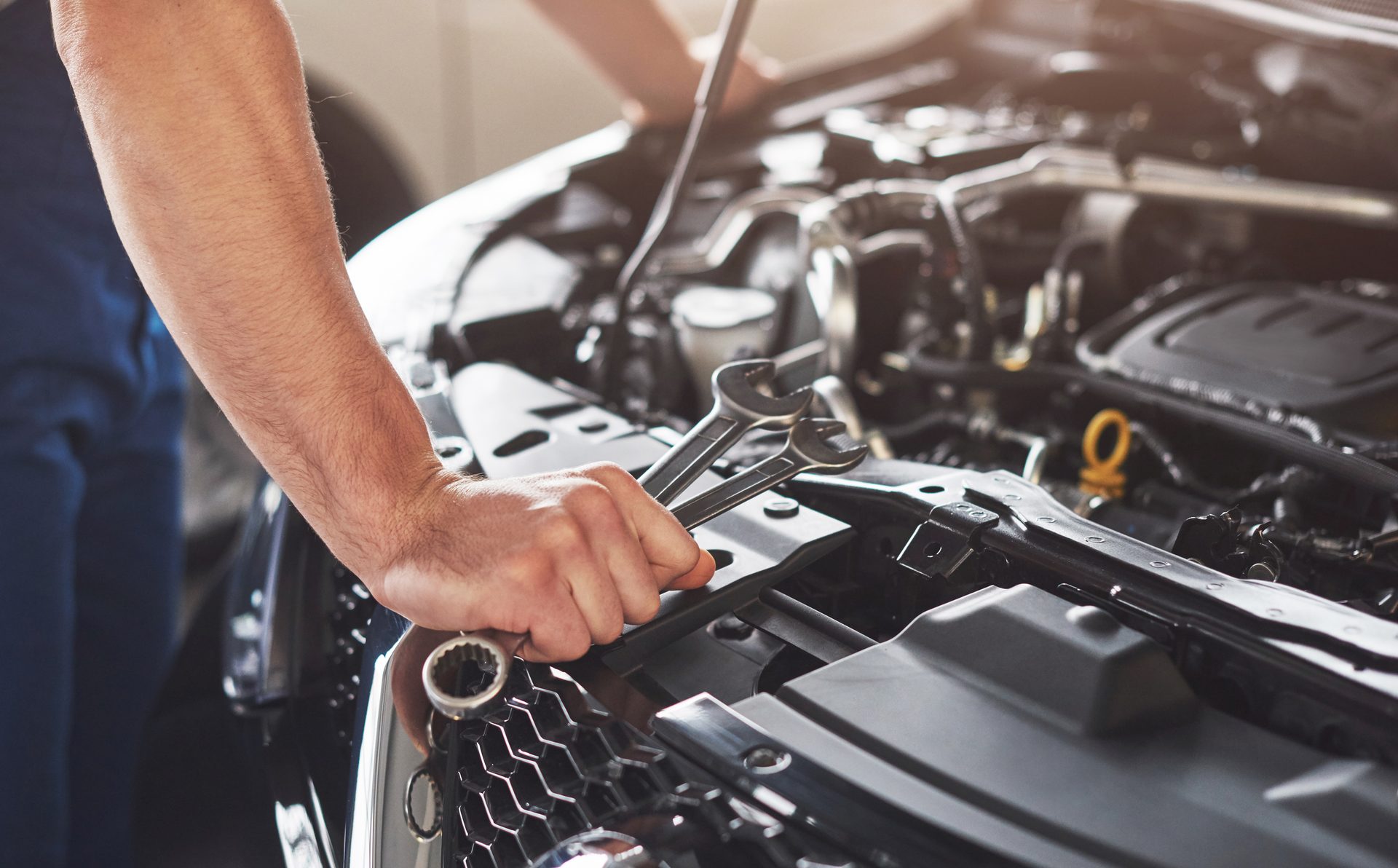
Your engine
sounds fine.
But is it really?
Most breakdowns start silently — weeks before any warning light. Film your engine for 30 seconds and two independent AI engines return a free health report in 10 minutes. No scanner. No garage. No $300 fee.
Engine check in three steps
Film 30 seconds of your engine running. No visit. No waiting. No $300 diagnostic fee.
30 seconds of your engine
Start the engine, point your phone at it for 30 seconds and upload the video. That’s the whole job.
100% free — just your email
No payment, no card, no subscription. Enter your email, send the clip — that’s it. The check is completely free.
Health report in 10 min
Health Score, a built-in AI second opinion, system-by-system status and a 6-month prediction — straight to your email.
Two AI engines. One honest verdict.
Every clip is analyzed twice — by hard spectral physics and by an independently trained acoustic neural net. A chatbot guesses. PulsCar measures.
Both engines have to agree. A confident fault from either one blocks a green report — the system can’t “look away” from a problem to tell you what you want to hear.
We’d rather ask you to re-record than guess. If your clip can’t support a confident verdict, your report honestly says “inconclusive” — and since the check is free, you can simply record again and run it once more. Nothing to lose.
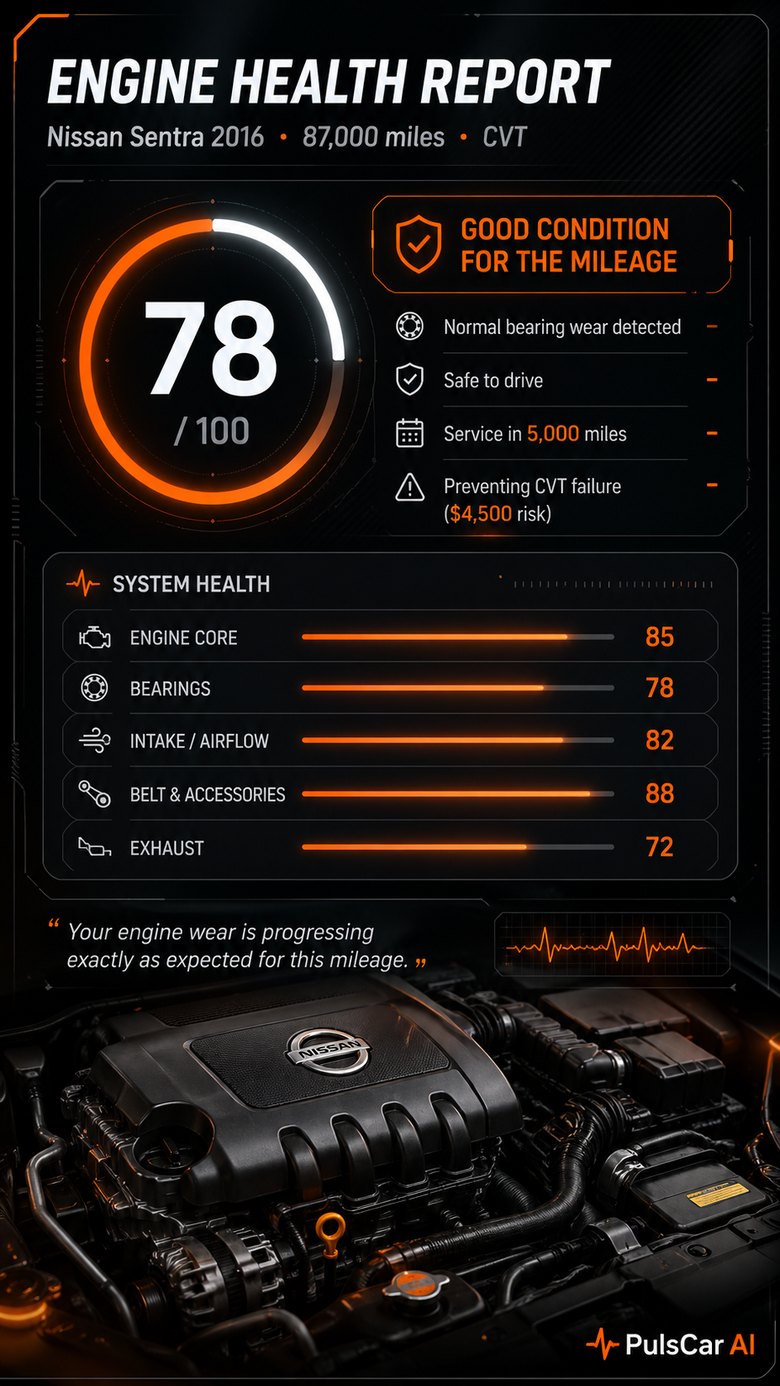
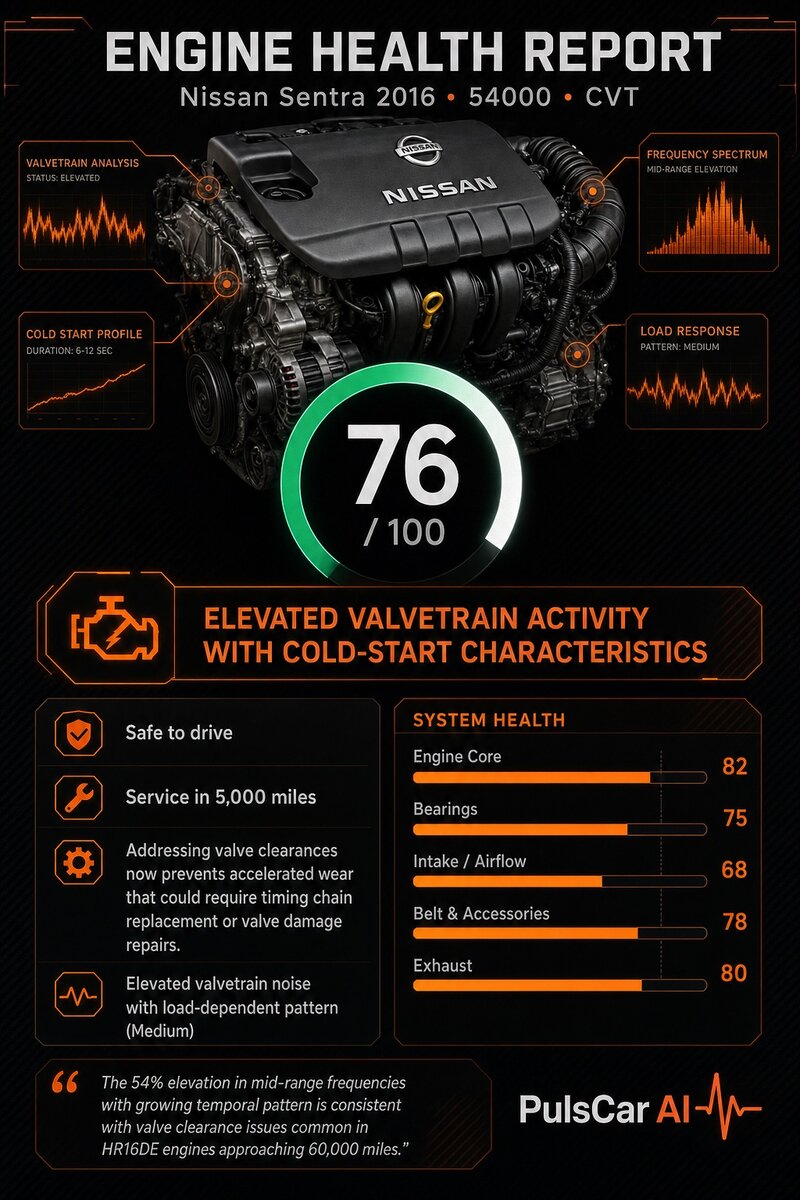
This is what your free check actually includes.
Not a vague "looks fine." A full diagnostic readout — the same depth a master tech would give you, generated from sound alone.
Worried about a specific sound?
Our AI handles all of these — but you can also read our detailed diagnostic guides.
Engine Knocking Sound
6 causes ranked by danger: from cheap fixes to rod knock. How to tell which one you have in 2 minutes.
Car Clicking When Starting
70% of "won’t start" cases are misdiagnosed. The $3 wire-brush test that saves $200+ on starter replacement.
Grinding Noise When Braking
Brakes vs. wheel bearing? The 30-second coasting test that tells you if it’s safe to drive home.
Car Shaking at Idle
Vibration troubleshooting: from $5 spark plug to $2,000 mount replacement. Park-vs-drive diagnostic test.
Car Squealing When Starting
Belt? Pulley? Power steering? AC compressor? 7 causes ranked by severity and repair cost.
Car Clicking Noise While Driving
CV joint? Lifter? Bad fuel? 8 causes from $0 fixes to $1,500 repairs. Driving vs. parked diagnosis.
Problems you can hear before they break
An OBD scanner reads error codes. PulsCar listens — the way an experienced mechanic does, just faster and without the markup.
How sound becomes a diagnosis
Watch one 30-second clip travel the PulsCar pipeline — from raw video to a priced verdict.
PulsCar vs the garage
 PulsCar AIPulsCar AI
PulsCar isn’t a replacement for major repairs — it’s the first-line diagnostic that helps you avoid wasted visits, catch problems early, and negotiate from a position of knowledge.
Why I built this.

I’d rather you trust your car than trust me.
It started with a weird noise I couldn’t place.
A shop charged me for a "full diagnostic" and called it a loose heat shield. Here’s what that actually cost:
The problem isn’t cars. It’s that we can’t tell what’s wrong without paying someone we don’t trust.
So I’m building a tool that listens to your engine and tells you the truth — free, and faster than a shop visit.
Read my full story →Questions?
Answered.
Everything you need to know before you film your first 30 seconds.
Email the founder directly — most replies land within a couple of hours.
[email protected] →01What exactly do I get in the free check?+
A full Engine Health Report by email within 10 minutes: your Health Score, current status of key systems, an independent AI Second Opinion, a 6-month prediction, estimated repair costs and recommended actions. Completely free — no subscription, no card.
02Do I need any special device?+
No. Just your phone. Film 30 seconds of your engine running, upload the video — it’s completely free — and we send the report to your email. No OBD scanner, no app, no Bluetooth pairing. The free check is separate from the PulsCar membership — an OBDLink MX+ scanner shipped with the app that reads your car on every drive (one payment, from $299.99 a year, sold at get.pulscar.io; details at pulscar.io/scanner).
03How accurate is the diagnosis?+
Every clip is analyzed by two independent AI engines: a spectral-physics analyzer measuring 30+ acoustic metrics, and a separately trained neural net built on real engine failures. A verdict is issued only when both agree — and if your recording can’t support a confident answer, you get an honest "inconclusive" report, not a guess. Final repair decisions should still be confirmed by a mechanic.
04What if I'm not satisfied?+
The check is free, so there’s nothing to lose. If the recording quality is too low for a confident verdict, you get an honest "inconclusive" report — not an invented diagnosis — and you can simply re-record and run it again. And if you have concerns about the result, contact support and we’ll review your case.
05What cars does this work for?+
Any gasoline or diesel internal-combustion vehicle. Make, model and year don’t matter as long as the engine produces sound. Electric vehicles aren’t currently supported.
06How do I film the engine correctly?+
Start the engine and let it idle 10 seconds. Open the hood, hold your phone 20–30 cm above the engine and film 30 seconds of video. Avoid wind, rain and background noise, then upload — MP4, MOV, MP3, M4A or WAV all work.
Install it now, then sign in with the email you bought with and activate your serial number. The scanner pairs in about thirty seconds.


